
Monday, 9 February 2015

Monday, 2 February 2015
Communications Post
Post on this Blog page any questions, theories, issues or dilemmas here, no matter what it is, so everyone can see it things such as: Not being in due to what reason, being ill, work not being done, questions about the work etc. - This is a last resort or for none urgent matters.
_______________________________________________________________________________
_______________________________________________________________________________
Start Post's Here:
AG (08/02/15): On the subject of the giant animal - During my research from what sources I can find, I have come to one idea on the exact giant animal to go with. I suggest that we as a group go with a marine animal. The primary reason for this suggestion is that, in addition to avoiding resorting to a turtle which we all know is a highly unoriginal move, it can evoke a mythological motif, like the primordial sea creature that was destroyed to make way for creation. My top two suggestions are the whale and the crocodile. The crocodile because it's unique (I've never seen it done over than in the Aztec myth of Cipactli) and the whale because it's flexible (it can be in the sky as well as the sea).


Research Existing Cities on Animals
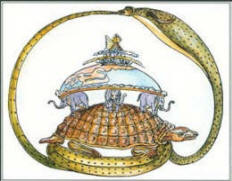
AG: The mythological concept of the world turtle or tortoise has many accounts within Indian mythology. A well known image of this myth is that of the world tortoise, the world serpent, and the world elephants. The tortoise is said to be identified as Kurma, or Kurmaraja, who is actually the second avatar of the deity Vishnu who was involved in the churning of the ocean of milk. The tortoise is also identified as Chukwa. Although a world turtle or tortoise is somewhat original for this project, it is a fine springboard to start with.

AG: The very same concept also appears in Terry Pratchet's Discworld, with elephants supporting the world as a disc, though without the serpent and the tortoise is a sea turtle. The turtle is called The Great A'Tuin. The presence of the Discworld has been discussed by the group, and the turtle is still not the best animal to go with.

AG: This image, originally created by Khalid Al-Muharraqi, represents a mythical sea monster known as a the Aspidochelone. It is a vast sea creature, usually a whale though sometimes a turtle or a giant fish, that carries an island on its back. It entices sailors with the appearance of the island on its back in order to pull them down under the sea and drown them. It also emits a sweet smell to lure and devour fish. The idea of a deceptive whale island is actually common in medieval literature, and also appears in Arabian Nights. The whale actually seems like an interesting area of conceptual consideration for the animal the city could be based upon.

AG: This image represents a giant fish or fish-like creature, called Jasconius, carrying the ship of Saint Brendan the Navigator on its back. Brendan and his companions would also return to the Jasconius to celebrate Easter on its back. Judging from the spouts of water coming from its head, the fish may actually be an old depiction of a whale, but the scales, fins, and tail still point to it being a fish. It inspires an idea for the city to be based around a ship and to be based atop a giant fish or fish-like creature.

AG and MF: This is concept for Stratus City from Ratchet and Clank: Tools of Destruction, drawn by Darren Quach of Insomniac Games. Here the city appears to be carried by giant space manta rays. The city is not necessarily being carried on the backs of these manta rays, but the idea can be a decent reference for the concept of a city attached to a sea creature.

AG: In Aztec mythology, the land was created from the corpse of a gigantic crocodile or caiman named Cipactli, shown in this depiction with corn growing from its back. Cipactli was created by the deities Quetzalcoatl, Tezcatlipoca, Xipe Totec, and Huitzilopochtli, along with water and other deities, but their creations would continually fall in the water and be devoured by it. Because of this, the four deities attacked and killed Cipatli, its corpse floated upon the water, and thus the land was created upon its back.

AG: Early myths about the Kraken suggest that it was the size of an island. The creature was even described as a floating island by the Bishop of Bergen when he wrote The Natural History of Norway in 1752.

AG: In the Bible, Leviathan is a giant sea creature described as a monster of chaos that is eventually destroyed by God. It could be a useful reference for the giant animal if it ends up being a giant marine animal.




Subscribe to:
Posts (Atom)